
America’s promise is broken. Our Common Purpose is to change that.
– Thomas Paine
On this Fourth of July in 2026, the 250th anniversary of our Declaration of Independence from British colonial rule, we the people of the United States of America now constitute a population of nearly 350 million—well more than twice our numbers at the end of World War II and far beyond the 2.5 million at the founding of our nation.
We still have much in common with the America of the 1950s. We still have the same Constitution. We still gather for Labor Day picnics and Thanksgiving dinners. We still watch fireworks on the Fourth of July in towns and cities across the country. Millions still tune in together for sporting events and the ball dropping in Times Square on New Year’s Eve. Our rituals remain familiar.
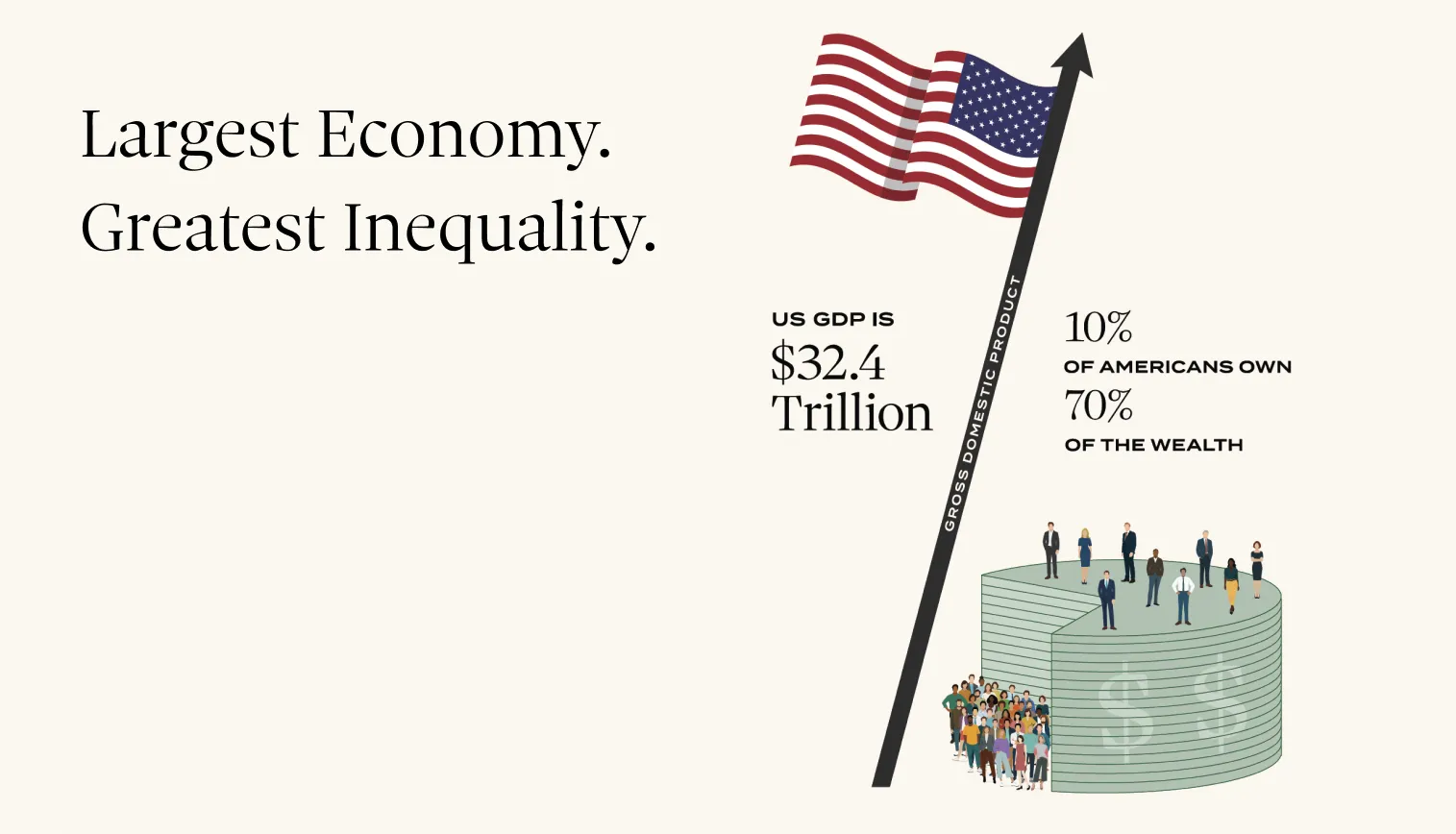
But our country is not exactly the same, nor do we see ourselves that way. In particular, we now have the widest income and wealth inequality of any industrialized nation in the world, while still being the richest country on earth.
Most working Americans feel this everyday as they struggle to make ends meet in whatever job they have. For some time, discussion of an “affordability crisis” has gripped the American populace. We find ourselves deep in political logjams, cultural divides, ethnic tensions, and uncivil discourse. Fewer Americans than at any point in two decades—only about 59 percent—expect their lives to improve in the future. We no longer seem to share a Common Purpose.
America used to be a country driving confidently toward a shared future. Even if we had a lot of problems, there was a time when all we had to do was identify what needed attention and, with the proper application of work—leaning in with our famous American ingenuity—the problem would at least begin to be solved. We believed that each successive generation would be better off than their parents, with even greater opportunities to make a thriving life for themselves and their own families.
That promise is what made America a model for the world, a place where people could go to school, find a job or start a business, and enjoy the assurance of future financial security no matter their line of work. America was where you could carve out your own little corner of the country, raise a family, and know that your children would be even better off than you, as would your children’s children.
Optimism was once a general feature of us as Americans, propelled by our national history of creating a middle class with good-paying jobs combined with a sense that America as a nation could accomplish anything if we set our collective mind to it.
Now, though, our nation is stuck. In measure after measure that once spoke to our greatness as a shining light to the world, the lived experience of working Americans is not what it used to be. We all want the same things—affordable housing and childcare, good schools for our kids, jobs that pay well enough to thrive—but wages, housing, and childcare are weighing people down. The American Dream, which once united us, is in tatters. Very few of us thrive; many of us barely survive.
Profound economic imbalance and the ills it spawns have stagnated our country. Economic mobility is stalled. Wealth accrues to fewer and fewer households. Stagnation has curdled into resentment, which has hardened into polarization. Politics has shifted from a contest of ideas to contention over grievances. And so we’ve separated ourselves into contentious, sometimes even warring “tribes,” turning neighbors into factions and policy debates into existential battles.
Being stuck can immobilize and obstruct. Something that fails to get unstuck may never move again. We are no longer moving forward with Common Purpose.
In 1776, Thomas Paine wrote Common Sense, a pamphlet that helped spur the creation of the United States. It was published at a critical point in our history as a nation. Paine advocated for a break with the colonial British power that was stagnating the progress of Americans in the New World. America, he argued, needed to make its own way—without Britain—on a path that gave it a common purpose, which was then spelled out eloquently, six months later, in our Declaration of Independence.
Just as Thomas Paine was prompted by the situation of his time, this pamphlet is prompted by today’s situation. Our country today is at another critical point in history—no less consequential for America’s future than were the circumstances of 1776. Like then, the crisis we confront has the potential to determine the trajectory of our country and its people for generation upon generation.
And so, following in Paine’s footsteps, this pamphlet advocates for a new unity of the American people motivated by a singular idea:
We as a nation should be judged by whether greater numbers of working Americans are thriving. That should be our Common Purpose.
This pamphlet is intentionally brief, no longer than is necessary to establish—with some data—the reality of a crisis readers will surely recognize. Then, just as Common Sense did, it issues a call to action, for all Americans to join together and build a movement to reverse our country’s trajectory and make it possible for all of our fellow Americans to realize the American Dream. It is a call to come together to replace the struggle to survive in our country with the opportunity to thrive, and to establish the very measures—the outcomes—by which we will know whether we are succeeding.
This pamphlet does not spell out specific policy or tax reform proposals, budgetary needs, programs to be started, or how to bring anything to scale. Its details are limited to what is needed to help give guidance for the debates that must happen among elected officials, leaders across all sectors, and, most importantly, everyday Americans.
As we celebrate 250 years of independence, we desperately need to restore hope and optimism across America. All of us should feel the hope that comes from making progress. None of us should be stuck. This is a call for a movement to get more Americans across this great land unstuck.
If we fail to find Common Purpose, our divisions will continue to widen and we will find ourselves hurtling at an even faster speed toward a future very different from what any of us want.
In Common Sense, Thomas Paine wrote: “Who the Author of this Production is, is wholly unnecessary to the Public, as the object for Attention is the Doctrine itself, not the Man.” So, too, with Common Purpose; as with Paine’s work, this pamphlet is written to draw your attention to the words—to what is advocated in these pages. As Paine described himself, the present author is “under no sort of Influence public or private” other than “reason and principle”—as well as that of compassion for all Americans and fear for what our future holds if we do not join in Common Purpose to act.
The historic American Dream, once a confident engine driving us all toward a prosperous, shared future, is seizing. We have become a country defined by the greatest wealth inequality in the modern world, with only a select few thriving while tens of millions of working Americans barely survive on incomes that don’t cover basic living costs. At the same time, the stock market and GDP continue to hit all-time highs.
For more than a half-century, trillions of dollars and countless social programs have attempted to salvage our foundational promise, yet they have failed to change outcomes at scale. Our focus on mere day-to-day survival has only fed Americans’ discontent and America’s stagnation.
America is at a tipping point.
In 1776, Thomas Paine called a nation to action in his pamphlet Common Sense. Now, 250 years later, Common Purpose echoes that call, outlining a new path forward to renew the American Promise. The pamphlet is intentionally brief, no longer than is necessary to establish—with some data—the reality of a crisis readers will surely recognize.
Common Purpose argues that we do not need to solve every massive crisis in one fell swoop, but we must empower Americans to decide where to begin to make progress on the specific challenges that make the most sense for their communities. To do so, we must augment the current measures with a targeted Outcomes Movement—a direct, disciplined pursuit of real and realistic outcomes in the critical areas that affect working Americans every single day: wages, housing, childcare, education, and health.
Published in the spirit of Thomas Paine, Common Purpose outlines what it will take to build an Outcomes Movement, proposes new measures that reflect the genuine lived experiences of working Americans, and provides examples of communities that have already begun to move the needle. An Outcomes Movement creates a sensible direction, ongoing dialogue, the necessary transparency, disciplined action, and true accountability. It’s a call to action for our country to unite around a Common Purpose: to judge ourselves by whether greater numbers of working Americans are thriving. It makes a statement of our values, of what we care about as a nation. Only when we share a clear understanding of what we’re working toward together can real progress become our Common Purpose.
Ways to continue reading Common Purpose
Mail Common Purpose
Receive a physical copy of Common Purpose in the mail.
"*" indicates required fields
Common Purpose & The Outcomes Movement

Andrew Wolk has spent more than 20 years helping communities achieve better results on challenges that no single organization or sector can address alone.
He is the founder of the nonprofits Root Cause, Social Innovation Forum, Interise, and most recently the Finding Common Purpose Foundation. Throughout his career, he has advised foundations, governments, businesses, school districts, and nonprofits across the country and has taught social entrepreneurship at MIT, Harvard, Boston University, and Boston College.
Common Purpose reflects the central lesson of his career: lasting progress happens when communities unite around outcomes, measure what matters, and hold themselves accountable for improving people’s lives. Through the Finding Common Purpose Foundation, Wolk is working to help communities across America renew the American Promise.
Common Purpose is a call to action to renew the American Promise. Drawing on the spirit of Thomas Paine’s Common Sense written 250 years ago, this pamphlet makes a simple but powerful argument: We as a nation should be judged by whether greater numbers of working Americans are thriving. That should be our Common Purpose.
The pamphlet outlines the need for an Outcomes Movement for working Americans – a disciplined, data-driven approach to improve people’s lived experiences in seven measurable domains: wages, savings, housing, education, healthcare, mental health, and childcare. It shows how communities can define what thriving means locally, measure progress, and hold institutions accountable to real results. It’s a blueprint for renewing the American Promise and transforming it into a measurable reality.
For more information about the data in Common Purpose please see here.
The Finding Common Purpose Foundation (FCP) is advancing a new outcomes-driven approach to philanthropy. FCP provides funding and partnership to communities that are committed to sharing measurable outcomes and aligning local efforts so that working Americans can thrive, not just survive.
Join the Outcomes Movement to Renew the American Promise
Get updates on how the Outcomes Movement is helping communities work together so more working Americans can thrive.
Read Common Purpose About The Outcomes Movement"*" indicates required fields